
Jul
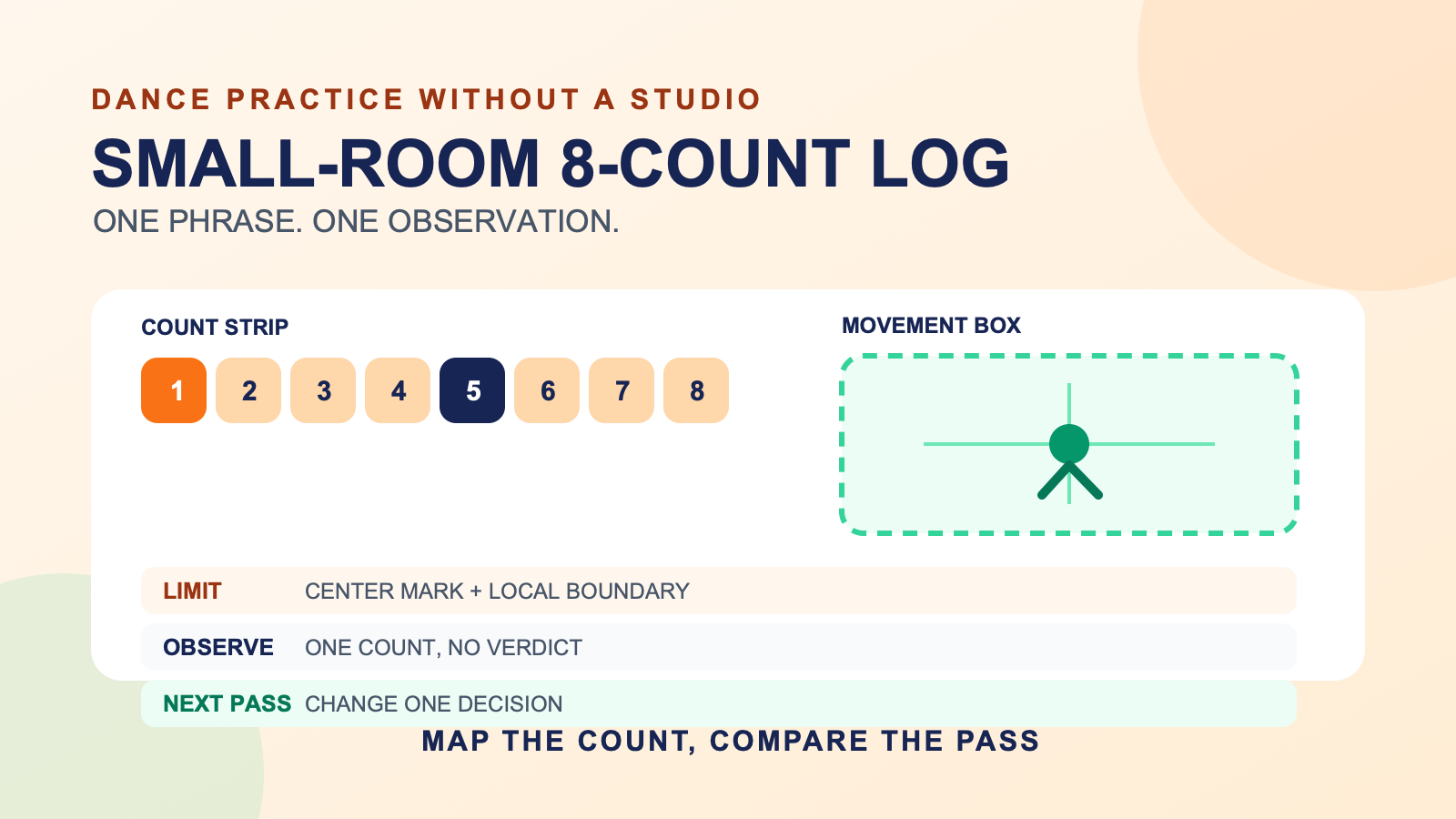
Full body tracking dance practice without a studio is easier to review when you reduce the session to one eight-count phrase. Clear a local movement box, choose one count that needs attention, record two or three short passes, and write the next adjustment in a small room eight count practice log. The log should capture the phrase goal, room limit, selected count, observed issue, and stop reason. It keeps the session focused on a comparison you can actually make in a compact space.
This workflow is not dance instruction and does not make a room safe. You remain responsible for the physical area, your comfort, platform rules, and any instruction you follow. The purpose here is narrower: organize a short avatar rehearsal without pretending that a bedroom or office is a studio.
Define the movement box before the phrase
Start with the physical space, not the virtual camera. Remove loose objects and identify a conservative area in which you can stop comfortably. If the phrase was designed for travel, adapt the rehearsal question rather than trying to force the original distance into the room. You might compare weight changes, facing, upper-body timing, or a smaller step pattern without claiming that the reduced version replaces the choreography.
Use the small-room setup guide for the full room check before this practice loop. A boundary drawn in software, a floor mark, or a camera frame does not prove that the physical area is clear. If you cannot create a suitable area, choose a non-moving review task or stop.
Give the movement box a simple note such as “center mark plus one comfortable step each side.” Avoid writing an exact distance unless you measured it. The note exists so that the next session starts from the same self-chosen limit.
Make a small-room eight-count practice log
| Log field | Example type of note | Why it matters |
|---|---|---|
| Phrase goal | Review the turn between counts 4 and 5 | Keeps the session on one question |
| Movement-box limit | Stay near center mark; no backward travel | Records the chosen local constraint |
| Selected count | Count 5 landing | Gives playback a precise review point |
| Observed issue | Avatar settles late after the turn | Describes what appeared without guessing why |
| Next adjustment | Repeat slower and change only the landing | Creates a comparable next pass |
| Stop reason | Room, comfort, tracking, or planned finish | Separates a completed session from an unresolved one |
Use observational language. “Foot looks late on count 5” is more useful than “tracking is bad” because it does not jump to a cause. The next pass can test whether the movement choice, avatar behavior, or technical baseline needs a separate check.
Run three short passes
- Map the phrase slowly. Move through the selected eight counts at a pace that lets you respect the movement box. The goal is to find where the planned phrase conflicts with the local limit.
- Run the intended timing. Perform only the chosen phrase. End, settle, and save the take or note before repeating it.
- Change one decision. Adjust the selected count, facing, or travel amount. Keep the rest of the phrase as consistent as practical so the comparison has a clear purpose.
Two useful takes can tell you more than a long recording full of unrelated changes. If the goal expands into planning a complete dance post, move to the dance-content planning guide. If the rehearsal is intentionally being shown live, use the streamed-practice guide. Those workflows have different audience and production decisions.
Review one count, then write the next pass
Watch the selected count at normal speed once, then slow the playback only if your recording tool supports it without changing the source. Look at the transition into the count, the shape at the count, and how the avatar settles afterward. Write one observation, not a verdict on the whole phrase.
For example, if the avatar appears to continue traveling after count 5, your next note could be “reduce the final step and compare the stop.” That note does not assume drift, timing error, or poor technique. It gives the next take one visible question. For broader dancer-use-case ideas, see the VRChat dancer guide.
Keep the files small enough to compare. A name such as `phrase-a_count-5_pass-02` is more useful than `final-final-new`. The log can point to the take and record whether you kept the adjustment, reverted it, or stopped the session.
Separate practice notes from technical problems
Pause the dance comparison if the neutral stance will not settle, a body location appears wrong, or the same unexpected offset continues outside the phrase. Use the setup and calibration workflow before another performance take. Changing calibration and movement at the same time makes the result difficult to read.
Likewise, a strap that shifts deserves its own check. Use the strap placement guide before the next dance comparison. Do not keep tightening or moving hardware during a dance loop and then treat the next take as a clean movement comparison.
Active movement also has limits that a content article cannot certify. Review the active VR safety guide, follow the equipment and platform instructions that apply to you, and stop if the local area or your comfort is not suitable. Finishing the planned log is never more important than stopping.
Choose gear after the practice need is clear
You can design the eight-count log before buying anything. It will show whether your intended review depends on waist and leg expression or can be completed with the setup you already use. If you decide that a SlimeVR-compatible route fits the workflow, inspect the current FBTKit product page for the live offer, compatibility information, included items, and terms. This article does not establish those details.
Return to the log after each session. Keep the chosen limit, one observed count, and the next comparison. That is enough history to resume without rebuilding the entire rehearsal from memory.
FAQ
What should I practice first when I do not have a dance studio?
Choose one eight-count phrase that can be reviewed inside a cleared, conservative movement box. Pick one count or transition to observe, rather than running a complete routine. If the phrase requires more travel than the local area allows, change the review task or stop.
What goes in a small-room eight-count practice log?
Record the phrase goal, your chosen movement-box limit, the count under review, one visible observation, the next adjustment, and why the session ended. Link the note to a short take if you recorded one under the rules that apply to the session.
How many takes should I record for one eight-count phrase?
There is no universal number. Start with a mapping pass, one pass at the intended timing, and one pass that changes a single decision. Stop earlier if the room, comfort, platform rules, or technical baseline makes another take inappropriate.
When should I stop the dance comparison and check tracking instead?
Pause when the neutral stance will not settle, a body location appears wrong, or the same unexpected offset continues outside the selected phrase. Confirm the technical baseline separately, then repeat the same movement question if it is appropriate to continue.
This planning workflow was prepared from local site evidence on August 11, 2026. It does not claim first-hand dance results, training value, safety, tracking improvement, or a live product specification.
