
Jul
Full body tracking for motion reference clips should produce neutral, labeled movement that can be studied later. Choose one movement question, record it from a stable angle, keep the take short, and save enough context to know what changed. Reference footage is not a polished performance and does not need dramatic framing. Its value comes from readable sequence and repeatable comparison.
This workflow is for artists, animators, creators, or learners who want an avatar-based visual note. It is not scientific measurement, biomechanics instruction, or proof that virtual motion exactly represents the real body. No controlled FBTKit test or creator outcome is claimed here.
Define one movement question
Write a question that can be seen in a short take: How does weight transfer read during a side step? Where does the torso begin to turn? What shape does the body make between a crouch and a stand? Avoid recording “””general movement,””” because a file without a question is hard to label or compare.
If the goal is martial arts practice or pose work, use the martial arts and pose practice guide for that use-case boundary. A reference clip can observe visible sequence, but it should not present itself as coaching or validate physical technique.
Create a motion reference card
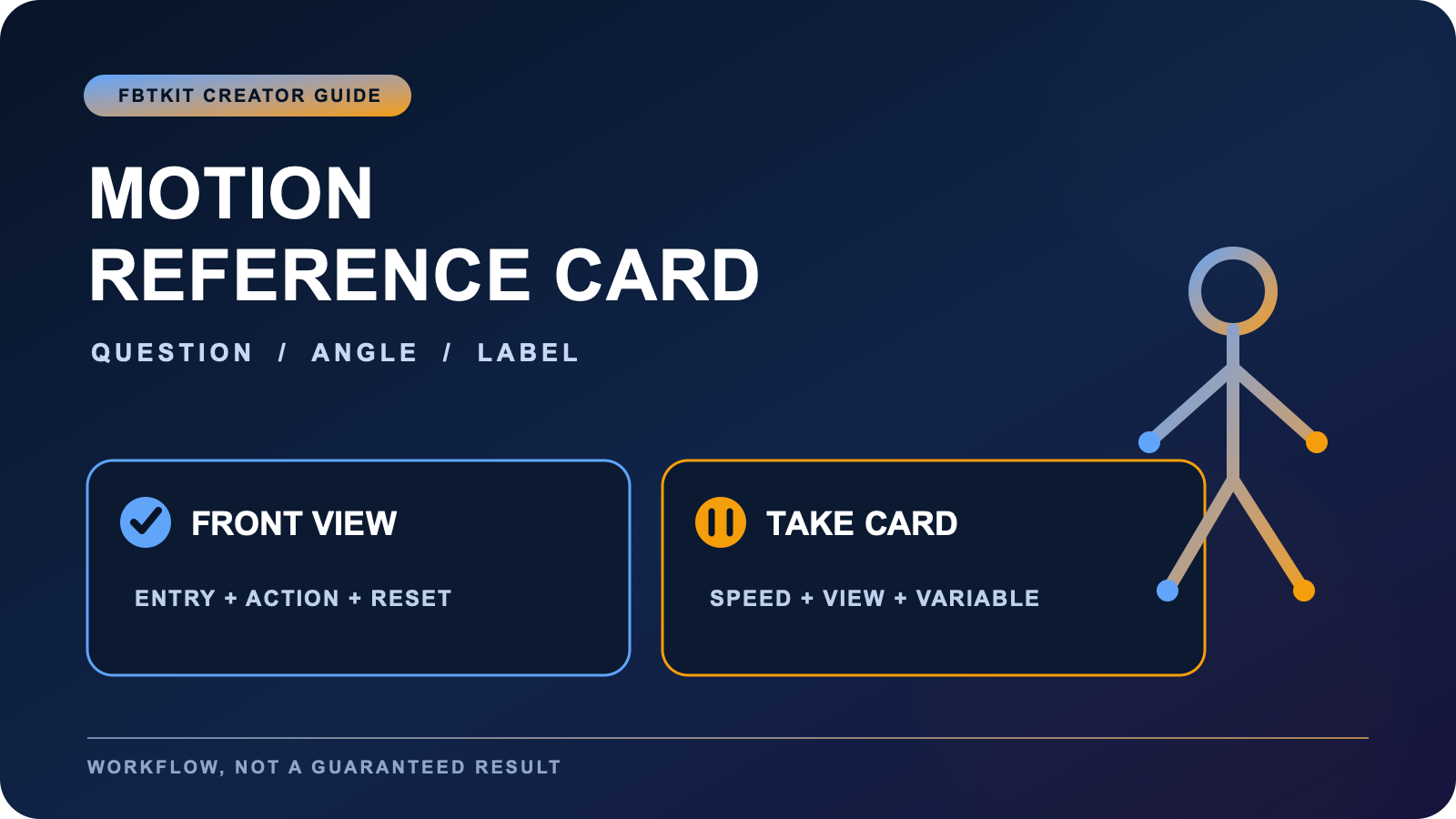
Give the clip a card with movement name, direction, speed, view, take number, and one variable. For example: `side-step / left / slow / front / t02 / shorter stance`. The card can be spoken at the beginning, stored in the filename, or written in a companion note.
| Field | Example | Why it matters |
|---|---|---|
| Movement | Turn and settle | Defines the study |
| View | Front or side | Explains visible relationships |
| Variable | Slower entry | Preserves comparison |
| Take | T03 | Connects note and file |
Do not put unverified claims such as “””accurate capture””” on the card. Describe what the file contains, not what it proves.
Use stable study angles
Begin with a front or three-quarter view that keeps the full body visible. Add a side view only when it answers the question better. Keep camera height, distance, and crop stable across takes you intend to compare. A dramatic moving camera can make a clip engaging, but it removes the consistent visual reference this output needs.
For a still-image output, use the avatar photography guide. A reference clip follows change over time and should include the entry and recovery, not only the most attractive frame.
Record entry, action, and recovery
Give the file a short neutral stance before the movement, the complete action, and a return or settled ending. These handles show how the body enters and leaves the main shape. Keep the take long enough to answer the question but short enough that its purpose remains obvious.
Record a slow version before a normal-speed version when speed changes are relevant. Label them honestly. “””Slow study””” and “””normal attempt””” are better than assuming one speed is correct. If the avatar or setup is new, run the new avatar test workflow before building a reference library.
Change only the stated variable
If the card says the variable is stance width, do not also change the camera, avatar, calibration, and movement direction. Repeat the same entry and recovery so the files remain comparable. When tracking behavior looks unexpected, return to a known setup and calibration workflow rather than editing the study around an unexplained symptom.
Visible jitter or drift can distort what you are trying to observe. The jitter checklist covers one technical symptom. Record technical limitations in the reference note rather than silently treating them as part of the intended movement.
Review sequence, not style
Watch the clip at normal speed, then step through the entry, midpoint, and recovery. Ask where weight appears to move, which body relationship is readable, and whether the selected angle answers the original question. Do not grade the clip by background polish, audience appeal, or character personality.
For character-driven acting, use the character performance guide. Reference footage may later support acting or animation work, but the reference file itself should remain descriptive and easy to retrieve.
Store the limitation with the file
Keep the question, card fields, selected file, and one limitation together. A limitation might be a narrow room, uncertain foot visibility, avatar proportion difference, or tracking symptom. This protects later users of the file from assuming it is a ground-truth measurement.
Organize a small reference set by movement first and date second. Put the front and side views of the same question together, and keep discarded takes out of the main comparison folder. When you revise the setup, begin a new version rather than silently replacing the older file. The older take may still be useful because it shows why a later decision changed. A reference library becomes harder to trust when filenames describe only mood or when the setup note is separated from the clip.
If another person will use the reference, include a one-sentence reading note. State what the clip is intended to show and what it should not be used to infer. That small boundary can prevent a neutral visual note from being mistaken for validated technique.
Before choosing a tracking route for this workflow, compare current written package information and compatibility on the FBTKit product page. Tracking can provide an avatar motion record, but it does not turn the file into medical, scientific, or coaching evidence.
FAQ
What makes an avatar motion reference clip useful?
It answers one movement question, uses a stable view, includes entry and recovery, and carries a label for movement, speed, direction, take, and the variable being tested.
How long should a motion reference take be?
Keep it only as long as needed to show the neutral entry, complete action, and settled recovery. Short purpose-built takes are easier to label and compare than long general recordings.
Why should reference clips avoid a moving camera?
A stable camera preserves the visual relationship among body parts across frames and takes. A moving camera can make it difficult to tell whether apparent change came from the body or the view.
Is an avatar motion reference clip a scientific measurement?
No. It is a visual study produced through a particular avatar, software path, room, and tracking setup. Record limitations and do not use it as medical, biomechanical, or coaching proof.
