
Jul
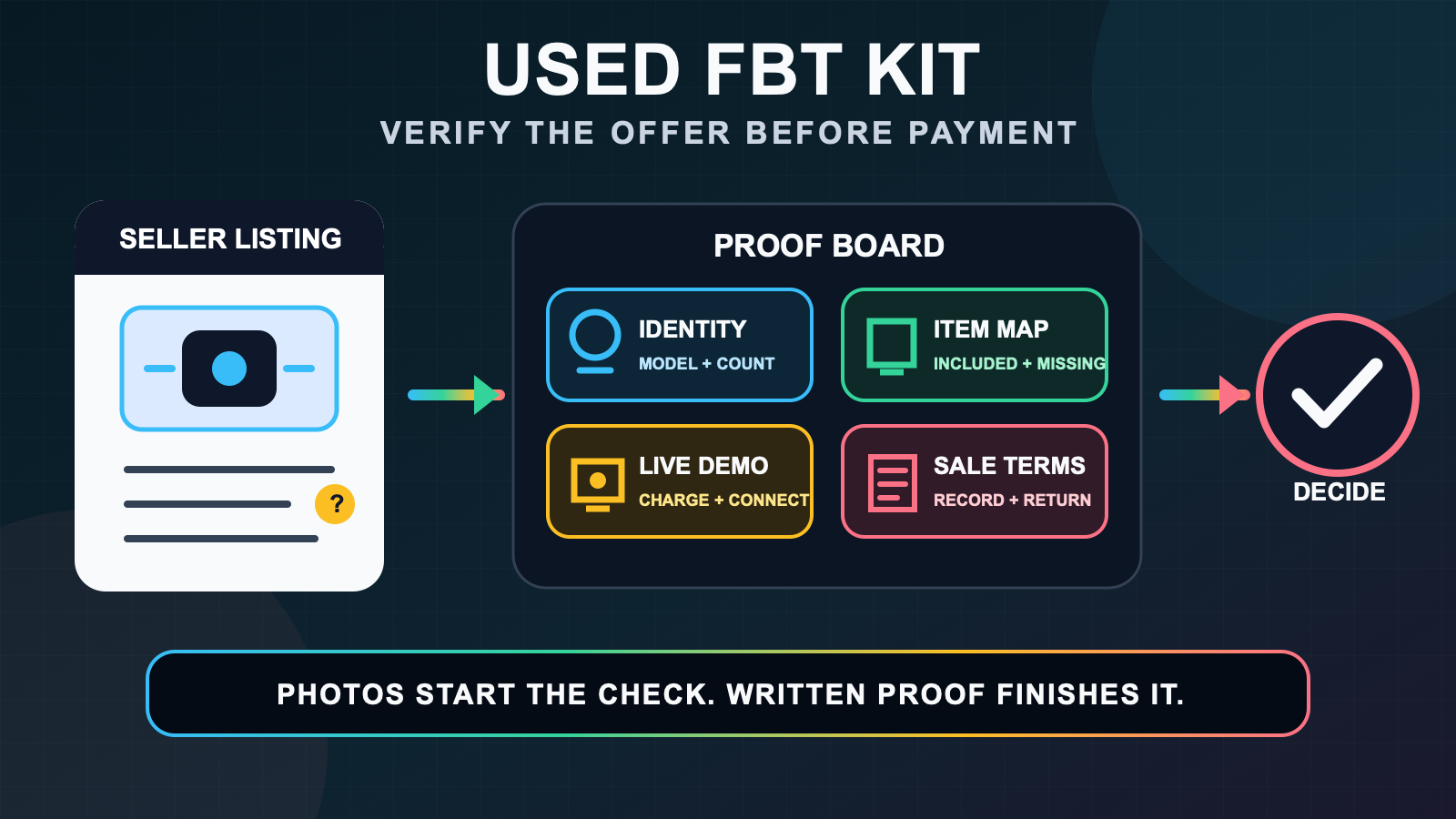
Before paying for a used full body tracking kit, get six things in writing: the maker and exact model of every device, the quantity of each item, the included accessories, an ordinary charging and connection demonstration, every software or account dependency, and the seller’s return terms. If the seller cannot prove an item that your setup needs, price the offer as incomplete or walk away.
Decide your tracking route and required body points before reviewing the listing. Use the general FBT buying worksheet for the broad route and the tracker-count guide to define the quantity you need. This page starts after those choices and asks whether one specific secondhand offer matches them.
Build the proof file before comparing price
A good used listing leaves a trail that another person could audit. Save the original listing, the seller’s itemized answer, dated images or video, the demonstration result, total cost, and the return terms. Keep each claim in its original message instead of copying only the parts you like into a note.
| Seller evidence | What it can support | What remains unknown |
|---|---|---|
| Readable labels and settings screens | Maker, model, visible revision, and device identity | Internal condition, ownership history, or compatibility with your route |
| One-frame item layout plus written count | Which physical pieces the seller says are included | Whether every piece works or whether an unshown item is required |
| Recent power, charge, connection, and movement clip | How each advertised unit behaves during that demonstration | Remaining battery capacity, long-session behavior, or future reliability |
| Written return and payment terms | The recourse the seller or platform states before payment | Whether a dispute will be decided in your favor |
Ask the seller to place a current listing code or agreed phrase in the frame. That does not make the evidence independent, but it helps distinguish a new demonstration from a reused clip.
Write an identity card for every device
Record the manufacturer, product name, model number, visible hardware revision, and quantity exactly as shown. Do not identify a tracker from shell shape or a vague listing title. If a label is missing, ask the seller to show the device in its official software or provide the manual that matches it, then mark the physical label as unresolved.
Extensions, dongles, receivers, base stations, and other components need their own rows when the advertised technology uses them. Do not assume that two similar-looking pieces have the same role. Your identity card should also separate a tracker from an extension or accessory that cannot operate alone.
Map included items against required items
Make two columns. The first is the seller’s exact included list. The second is everything your intended route requires. Put straps, mounts, charging cables, data cables, adapters, receivers, and power supplies in the appropriate column only when the listing or official setup documentation supports them.
The current kit contents reference shows how to read a new product listing by named quantity. It does not prove what a private seller includes. Ask the used seller to reconcile every row, then price replacements and shipping before comparing totals.
A missing comfort accessory may be replaceable. A missing route-specific component may prevent the intended setup. Keep those consequences separate rather than treating all missing items as equal.
Ask for an ordinary charge and connection demonstration
The seller should show every advertised unit receiving normal charge or reporting its normal charge state, then power the units on and connect them through the software path named in the listing. For a claimed SlimeVR setup, the official server can list connected trackers and identify a unit when it moves. Ask the seller to move one physical unit at a time so the list can be matched to the item count.
The clip should also show where the chain ends. Appearance in a tracker server is not the same checkpoint as appearance in SteamVR or a supported OSC application. Ask which route was demonstrated and which host, headset, and application were used. If a unit does not appear, the detection decision path explains the failure layers, but a seller’s unresolved failure should not be relabeled as a complete working set.
A short charge or power-on clip proves only what happened during the clip. It does not establish battery health, remaining capacity, or expected session length. Do not ask the seller to open the case, deliberately run a battery flat, heat it, compress it, or perform another stress test.
Record exterior condition without turning it into a verdict
Request clear views of cases, ports, cable ends, attachment points, straps, clips, and any repaired area. Note cracks, deformation, looseness, fraying, missing fasteners, or residue as visible observations. Ask what happened and whether the repair changed normal use, but do not infer the condition of parts hidden inside the housing.
Detailed image interpretation belongs in the seller-image evidence guide. Even good images cannot prove battery capacity, firmware state, account status, ownership, or a successful connection. Use images to decide what the seller must demonstrate next.
List every software and transfer dependency
Write down the exact headset, host device, application, connection method, required driver, firmware family when known, and any official account or license requirement. A statement such as “works with VR” is not specific enough. If the intended application is VRChat, use the VRChat route guide to define the path that the seller needs to demonstrate.
Do not rely on continued access to the seller’s personal account. Ask whether the hardware can be reset, unpaired, registered, or transferred through an official process and request the relevant documentation. If a subscription, license, activation, or account entitlement is non-transferable or unclear, mark it as missing until the platform or manufacturer confirms otherwise.
DIY or modified hardware needs a written configuration record. A seller’s claim about custom firmware, hardcoded network details, or replaced parts is useful history, but it is not a compatibility guarantee.
Turn seller promises into written exit terms
Save the item description, condition words, quantity, demonstration, known faults, total price, fees, delivery promise, and return terms. The U.S. Federal Trade Commission advises online shoppers to record manufacturer or model numbers, read return and refund policies, calculate total cost, and keep receipts and seller communications. Buyers outside the United States should check the rules and marketplace protections that apply where they live.
Keep payment inside the marketplace or another channel that preserves the protection you are relying on. Get the return window, accepted reasons, return-shipping responsibility, and any fees in writing. A verbal promise made after payment is a weaker record than a term included in the listing or message thread beforehand.
Choose stop, clarify, or continue
| Decision | Evidence state | Next action |
|---|---|---|
| Stop | Identity or count changes, the seller refuses a normal demonstration, a required transfer is impossible, or the payment request removes the stated protection | Do not pay for the offer as described |
| Clarify | A replaceable item, software dependency, visible condition issue, or return term remains unresolved | Ask one written question and update the cost sheet |
| Continue | The exact item map, ordinary demonstration, dependencies, total cost, seller record, and return terms match the route you chose | Save the complete proof file before payment |
If the demonstration exposes a symptom rather than a clean pass, use the general FBT symptom router to name it. Do not let the troubleshooting plan replace the seller’s obligation to describe the current condition.
For a new-product comparison point, review the current FBTKit product listing. That page describes a new FBTKit offer. It is not a secondhand listing and does not verify any private seller’s model, contents, condition, compatibility, support, or return terms.
FAQ
Which identifiers should a used tracker seller provide?
Ask for the manufacturer, product name, model number, visible hardware revision, and exact quantity for every tracker or extension. Match readable labels to settings screens or official documentation instead of relying on shell shape.
What does a short charging demonstration prove?
It can show that each advertised unit accepts or reports normal charge during that recording. It does not prove remaining battery capacity, expected session length, or future reliability.
How should every tracker appear in a connection demonstration?
The seller should show the advertised unit count in the intended server or application path and move one physical unit at a time so each list entry can be identified. Record which route and host were used.
Should a used kit depend on the seller’s personal software account?
Do not rely on continued access to someone else’s account. Verify whether registration, activation, licenses, or entitlements can be reset or transferred through an official process before payment.
Which records should I save before paying?
Save the original listing, itemized count, condition statements, recent demonstration, known faults, total cost, seller messages, delivery promise, return terms, and the payment receipt.
Official sources
