
Blog
When to Replace Full Body Tracking Straps
Jul
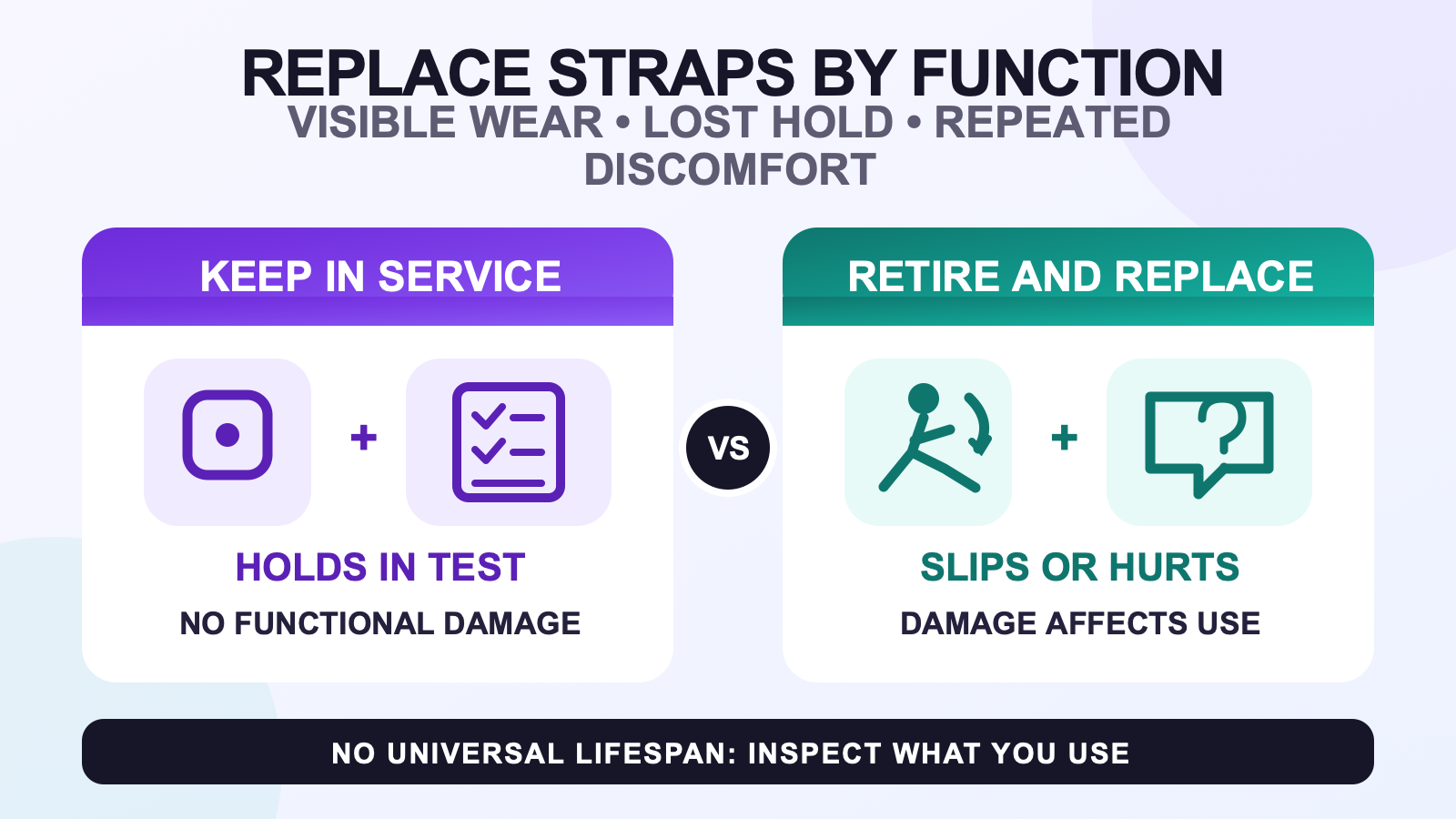
Replace full body tracking straps by function, not by a guessed age. Retire a strap when a correct placement test still cannot hold the tracker, when visible damage affects fastening or the mount interface, or when persistent discomfort remains after a structurally sound fit is checked. There is no universal month, session, or wash count that applies to every strap and use pattern.
Appearance alone is not the decision. A faded but intact strap may still hold. A clean-looking strap can fail if stitching separates under normal tension or the tracker mount has deformed. Inspect the part in good light, compare it with its known working state, and use one controlled movement test before active VR.
Sort the strap into adjust, care, or retire
| What you observe | Decision | Reason |
|---|---|---|
| The strap is intact but sits on a different body point or clothing layer than usual. | Adjust and retest. | Placement and clothing can change hold without proving structural wear. |
| The fastening is contaminated with lint or debris, but stitching, elastic sections, edges, and mount interface remain intact. | Use applicable care instructions, dry fully, then retest. | Contamination may affect fastening, but the cleaning method must match the material and product guidance. |
| The fastening opens during a controlled step, bend, or turn after correct placement and approved care. | Retire from active use. | The strap no longer performs its basic holding job in normal movement. |
| Load-bearing stitching is torn, separated, or pulling away. | Retire before the next session. | Further testing can increase the damage and release the tracker. |
| The tracker-mount interface is cracked, deformed, loose, or no longer retains the device as designed. | Retire the affected strap or mount. | A sound textile section cannot compensate for a failed device interface. |
| A hard edge is exposed or the strap causes persistent discomfort despite correct placement. | Stop using it and reassess. | Continued tightening is not a valid fix for a damaged or unsuitable contact point. |
| The strap looks older but passes inspection, placement, and the normal movement test. | Keep in service and monitor. | Age or appearance alone does not prove functional failure. |
This matrix deliberately avoids a universal replacement calendar. Movement intensity, body location, storage, care, travel, fastening design, and construction can change wear. Without the supplier’s material specification or a measured test, a fixed lifespan would be an invention.
Run one controlled hold test
- Inspect unloaded. Remove the tracker and examine stitching, fastening surfaces, elastic or adjustable sections, edges, and the mount interface in bright light.
- Confirm the correct body role. Check the expected location and orientation. SlimeVR’s official mounting guidance says tracker role and mounting orientation should match the body part.
- Use known clothing. Choose the layer on which the strap previously worked. Slick, loose, or bunched fabric can create a placement issue that looks like wear.
- Install without maximum tightening. The tracker should stay in a repeatable position without pinching or restricting normal movement. Use the strap placement guide for detailed body-point decisions.
- Test one normal movement. Take a controlled step, bend, or turn that the strap previously handled. Stop if the fastening opens, the mount moves independently, or a hard edge appears.
Do not use the most aggressive dance move as a proof test. The question is whether the strap can still perform its normal holding function. If it fails a familiar, controlled action after correct placement, more force or tighter compression does not restore the original function.
If the strap remains secure but the avatar still jitters, drifts, disconnects, or shows the wrong role, the problem may be elsewhere. Use the tracking symptom checklist rather than replacing a strap that passed its physical test.
Use cleaning only for a structurally sound strap
Cleaning is a care step, not a structural repair. If lint or surface contamination may be reducing fastening grip, follow the applicable product instructions and the strap cleaning guide. Allow the item to dry fully by the approved method before retesting.
Do not clean and retest a strap as a way to ignore torn load-bearing stitching, a cracked mount, severe distortion, or an exposed hard edge. Do not invent a solvent, machine-wash setting, adhesive repair, heat-drying method, or sewing repair for an unknown material and load path.
Good storage can prevent avoidable distortion and contamination, but it cannot reverse structural failure. Use the between-session storage guide for separation and containers. After transport, the travel gear checklist can help you inspect before wearing the setup again.
Treat persistent discomfort as functional evidence
First separate the strap from the clothing, body point, and session duration. Test the same structurally sound strap in its intended position with known clothing. Check whether the pressure comes from a fold, twisted section, exposed edge, or the device mount rather than simply assuming the strap is too loose.
If correct placement and a sound surface still produce persistent pinching, abrasion, pressure, or altered movement, stop using that strap for the session. Do not keep tightening or adding improvised padding that changes tracker orientation. Use the long-session comfort guide for a broader wear review. Comfort that cannot be corrected is a valid reason to choose a different intact strap or mounting solution.
For active sessions, use the active-session safety guide and make strap shift or discomfort an explicit stop condition. A tracker can remain connected while its physical mounting has become unsuitable.
Retire one failed part without inventing a set rule
When one strap fails, inspect every strap because they may share a use and storage history. Replace the failed part when an appropriate replacement exists, but do not assume the whole set must be discarded or that the remaining straps are automatically sound. Each strap must pass its own inspection and hold test.
Record the body role, observed damage or failure, clothing, movement, and action taken. This helps separate a repeated placement problem from a part that reached the end of useful service. It also gives support a factual description without asking them to infer the issue from “it feels old.”
Keep product facts separate from replacement availability
The current FBTKit kit configuration and included-item information can show what the product page presently includes. This article does not claim a strap material, warranty result, separate replacement-part listing, stock state, or lifespan. Confirm any order or part question from the current product and support information.
FAQ
Is there a fixed replacement schedule for full body tracking straps?
No universal schedule is supported. Replace by observed function and condition: loss of hold after a correct test, damage that affects fastening or mounting, or persistent discomfort that a sound placement cannot correct. Follow any specific inspection or retirement rule supplied by the strap maker.
Does a slipping tracker strap always need replacement?
No. First confirm the body point, orientation, clothing layer, fastening condition, and applicable care instructions. If a structurally sound strap still slips during a familiar controlled movement after those checks, retirement is more reasonable than repeated tightening.
Which visible damage means I should retire a strap before the next active session?
Retire it when torn or separated load-bearing stitching, a cracked or deformed mount interface, fastening that opens in a normal test, severe distortion, or an exposed hard edge affects secure use. Do not rely on an improvised repair for an unknown load-bearing part.
Can I keep using a strap that becomes uncomfortable only in longer sessions?
Stop and check placement, clothing, folds, edges, and the mount. If correct placement on a structurally sound strap still causes persistent discomfort, do not keep tightening it or extending the session. Choose a different intact fit or mounting solution.
Should I replace every strap when only one fails?
Not automatically. Retire the failed strap, then inspect and test the others individually because they may share the same history. Replace any other part that fails its own condition and hold check, while keeping sound parts in service when the applicable product guidance allows it.
Official sources
Official sources and linked FBTKit pages were checked on August 11, 2026. No supplier material specification, lifespan, wash-cycle test, seam-force test, or FBTKit replacement result was supplied, so this guide uses observable function rather than a fixed age.
