
Jul
Full body tracking group dance worlds are easier to rehearse when everyone shares the same named formation, start cue, count reference, transition cue, finish, and reset. A group dance run sheet and cue matrix put those decisions in one place so a host does not need to explain the entire pass while people are already moving.
Shared cues do not remove network delay, local display differences, calibration problems, or jitter. The run sheet coordinates decisions. It cannot guarantee synchronization, safety, recording quality, or a successful event.
Define one pass and assign minimal roles
Begin with one pass that has a clear start and finish. Name the movement phrase, two or three formations, the transition between them, and the final hold. If the plan needs several songs or many camera routes, split it into separate sheets. A short sheet can be repeated and corrected; a crowded one becomes a script nobody can scan.
Assign only the roles the pass needs. A host calls the start and reset. A count lead gives the agreed count reference when that differs from the host cue. A camera operator or observer records the intended frame and one review note. One person may hold several roles, but the sheet should say who makes each decision.
Individual movement preparation remains personal. The VRChat dancer guide covers the single-dancer use case. The group sheet begins where participants need a shared formation and cue language.
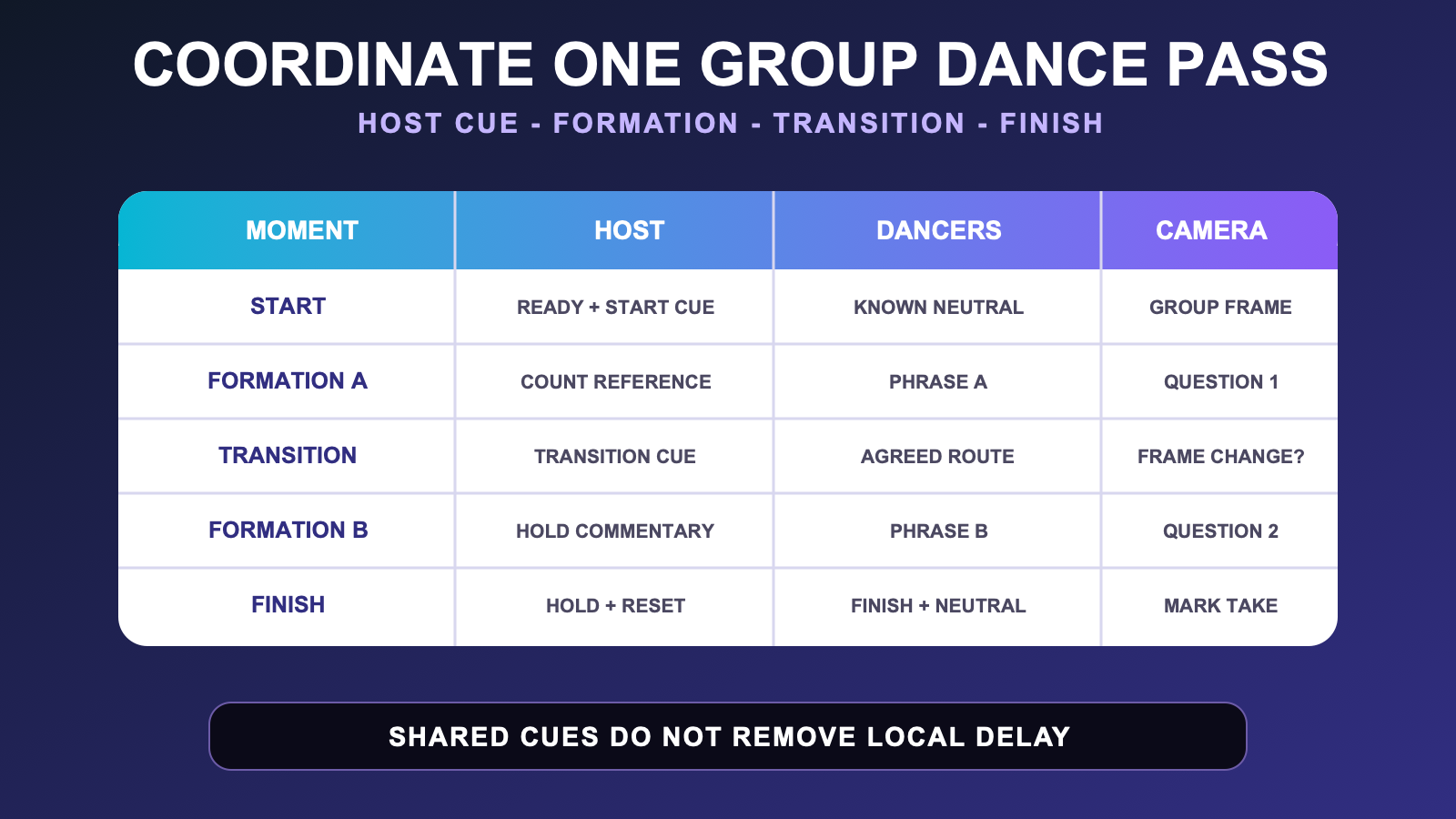
Build the cue matrix
| Moment | Host | Dancers | Camera or observer |
|---|---|---|---|
| Start | Call the agreed ready and start cue | Confirm formation A and neutral | Confirm the planned group frame |
| Phrase A | Give the common count reference if needed | Perform the named phrase | Watch one formation question |
| Transition | Call the transition cue | Move to formation B by the agreed route | Keep or change the frame as written |
| Phrase B | Hold nonessential commentary | Perform the second named phrase | Watch the planned spacing or silhouette question |
| Finish | Call hold, end, and reset | Settle the finish, then return to the agreed neutral | Mark the take and one review note |
Write cues as exact words or actions when ambiguity would matter. “Go on the next beat” is less useful than an agreed phrase or count. Keep creative detail in the dance content planning guide; the cue matrix needs only the final names and transitions required for this pass.
Label formations and transitions plainly
Use labels the group can recall, such as line, shallow V, paired, or two-row. Add participant initials or role names only when positions matter. Do not assume a formation marker in a virtual world proves that every participant has a suitable physical area.
Each dancer remains responsible for a cleared local movement area and the limits of their own setup. The small-room setup guide can help a participant adapt their local plan. The group may also reduce travel, simplify a turn, or assign a stationary role when a person’s available area differs.
For each transition, write the route and the end state. “Cross behind to left point” tells more than “switch places.” If two people would use conflicting paths, correct the matrix before rehearsal rather than relying on a last-second virtual adjustment.
Rehearse cues before recording
Run one cue-only pass at reduced movement. Participants confirm formation names, start signal, transition cue, finish, and reset. The goal is to learn the shared decisions, not to evaluate the dance. Correct the sheet when two people interpreted the same cue differently.
- Call ready and confirm formation A.
- Walk or mark phrase A with the agreed count reference.
- Move through the transition route without adding performance detail.
- Confirm formation B and the final hold.
- Use the end and reset cues exactly as written.
When the pass is intended for a live presentation, use the streaming dance practice guide for stream-specific preparation. A group rehearsal can still use the same cue matrix, but the camera and communication requirements may need their own version.
Keep timing cues and technical symptoms separate
A shared count gives the group a common reference; it does not prove that every participant sees or hears the same moment. If timing looks different, first ask whether the group used the same cue and formation plan. Then let each participant investigate repeatable local symptoms through the relevant process.
The latency review guide covers practical delay questions, while the jitter guide covers unstable motion symptoms. Do not rewrite either issue as a choreography mistake, and do not claim that a host cue fixes technical delay.
If a participant needs a pause, loses the known baseline, or cannot continue the agreed movement, use the reset cue and stop that pass. Resume only when the person confirms their own readiness. The group sheet coordinates the stop; it does not certify local conditions.
Review one group-level question
After the pass, ask one question tied to the matrix: Did formation B read as a V from the chosen view? Did the transition finish before phrase B? Did the final hold settle together after the cue? Avoid scoring individual technique or comparing hardware from a single take.
Write one change into the next version. It may be a clearer formation label, a different transition route, a longer ready pause, or a camera note. Keep the other rows stable so the group knows what changed. Obtain permission before recording, saving, or sharing participant footage, and follow the world and platform rules that apply.
Participants do not need identical tracking choices simply because they share a formation. The tracker-count guide helps an individual connect body roles to their own goal. The group sheet should record any role constraint that affects the pass, not prescribe a purchase.
Compare a product only with a defined personal requirement
If one participant decides that waist and leg expression matter to their assigned role, they can compare that requirement with the current FBTKit product page. Verify compatibility, contents, price, stock, and terms on the live page. Matching hardware does not remove group timing differences or guarantee a creative outcome.
FAQ
What belongs on a group dance run sheet?
Record the pass name, roles, start cue, formation labels, movement phrases, transition routes, common count reference, camera or observer question, finish, reset, and one review decision. Split a long program into separate sheets.
How should a group handle timing differences in a dance world?
Agree on one host cue and count reference, then confirm that everyone followed the same matrix. Shared cues support coordination but do not remove network or local technical differences. Route repeatable latency or jitter symptoms to their separate checks.
Does every dancer need the same number of trackers?
No. Each participant should choose a tracking route for their own body-role and movement goal. The group can adapt formations or assigned parts when capabilities differ rather than treating identical hardware as a requirement.
What should the group review after one rehearsal pass?
Choose one group-level question about a formation, transition, shared cue, frame, or finish. Record one change for the next version. Do not use one take to score individual technique, tracking accuracy, or equipment quality.
