
Blog
Full Body Tracking for Roleplay and Immersive Social VR
Jul
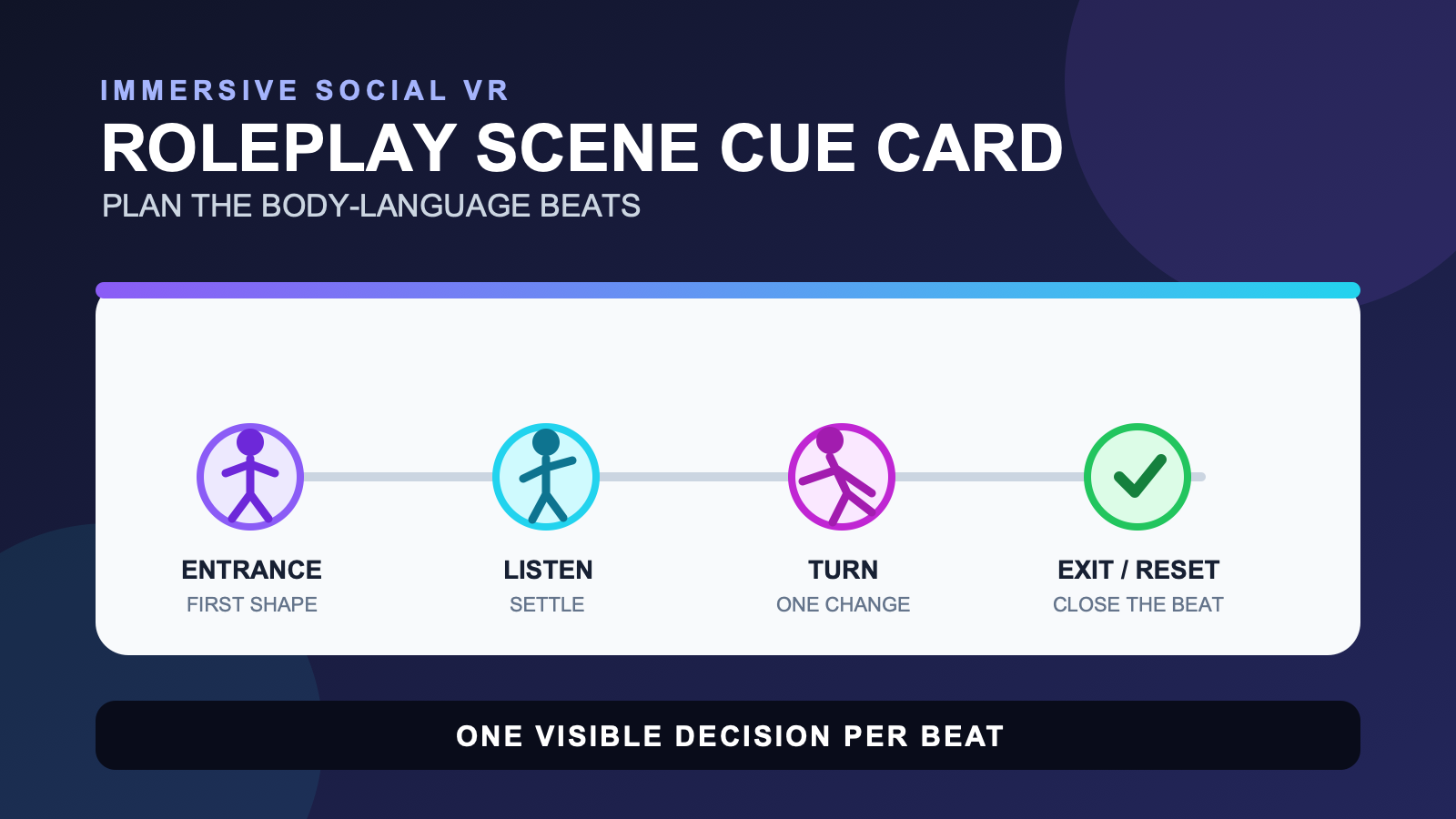
Full body tracking for roleplay works best when you decide what each movement means before a scene starts. A roleplay scene cue card gives you that decision in a compact form: write the scene purpose, entrance shape, listening posture, emotional turn, and exit or reset cue. Then rehearse those five beats with the avatar you plan to use. The card keeps body language consistent enough to read while leaving room for the other person to respond. It also stops the session from becoming a stream of unrelated gestures.
This is a rehearsal method, not a promise that tracking makes a character convincing. The scene still depends on timing, consent, the avatar, the world, and the people in it. Full body data simply gives you more posture choices to plan and review.
Use movement to clarify the scene
Start with the change that should be visible. A guarded character may enter with a narrow stance and keep weight slightly back. A curious character may lean toward a speaker, then settle when they listen. Someone who receives bad news may reduce movement instead of adding a dramatic flail. The useful question is not “What can my trackers show?” It is “What must another person understand at this beat?”
Choose contrast over constant motion. If the entrance is busy, let the listening beat become quiet. If the scene begins with a relaxed stance, make the turn visible through a clear change in weight, distance, or hand position. Stillness is part of the vocabulary. It gives the next motion a reason to be noticed.
For deeper acting work, use the character body-language guide. The scene card here stays focused on the practical rehearsal sequence.
Build a roleplay scene cue card
| Card field | Write one decision | What to review |
|---|---|---|
| Scene purpose | What changes between the start and end? | Can you name the change in one sentence? |
| Entrance shape | Wide, narrow, open, guarded, hurried, or still | Does the first silhouette fit the character’s intent? |
| Listening posture | Where the torso, feet, and head settle | Can the other person tell you are listening? |
| Emotional turn | One visible change in weight, distance, or level | Is the turn different from the baseline? |
| Exit or reset cue | A line, sound, or action that closes the beat | Can you return to neutral without confusion? |
Keep each field short. “Back away on the accusation” is easier to perform than a paragraph about fear. A cue card should be glanceable before the scene, not read while someone is speaking. If the scene has several emotional turns, make another card rather than compressing the whole encounter into one sequence.
Rehearse four beats in order
- Enter and stop. Cross into the planned frame or conversational distance, then settle. Review the silhouette after the stop, not only the walk.
- Listen without filling the pause. Hold the chosen posture through a short imagined response. Check whether idle movement fights the character choice.
- Make one emotional turn. Change one primary variable. Shift weight, lower the stance, open the chest, or increase distance. Do not change everything at once.
- Exit or reset. Use the chosen cue and return to a known neutral posture. A clean reset makes another take easier to compare.
Record a short private reference if your platform and group rules allow it, or ask a scene partner for a simple observation. The review question should stay narrow: “Did the listening beat look separate from the turn?” Avoid asking whether the entire performance was good. A broad answer rarely tells you what to change.
When the avatar itself is unfamiliar, complete the new-avatar test before you judge the scene. A model-specific proportion or movement issue can otherwise look like an acting choice.
Adapt the card to the scene space
A seated conversation needs different contrast from a standing confrontation. You can vary torso angle, foot placement that remains comfortable, hand rest, and how far the avatar turns toward a speaker. Use the seated-session guide for the physical and technical route. The cue card should only record the body-language decision that fits that route.
For a compact room, replace travel with level, facing, and distance changes that stay inside the cleared area. Marking one neutral position can make repeated takes easier to compare. For the physical room audit, use the small-room setup guide. Do not assume that a virtual scene boundary proves the physical area is clear.
Group scenes need social coordination as well as posture. Check the social VR meetup guide for shared-session boundaries. A cue card should never override another participant’s comfort, timing, or platform rules.
Review one variable per take
Give each rehearsal take a single question. Take one might check whether the entrance stops cleanly. Take two might compare two listening postures. Take three can test whether the emotional turn is visible at the intended camera or conversational angle. Write one note beside the cue, then keep or replace that decision.
Avoid treating every wobble as a performance problem. If the neutral pose moves unexpectedly, the avatar does not settle, or body locations look wrong, pause the scene work. The setup and calibration workflow is the right next step. Fixing a technical baseline and changing an acting beat in the same take makes the result hard to interpret.
The same separation applies to general pose study. Use the avatar pose practice guide when the goal is to compare silhouettes outside a scene. Keep the roleplay card tied to what the character wants and what changes during this encounter.
Decide whether the hardware route fits the plan
A cue card can be useful before you choose a tracking system because it reveals the body-language beats you care about. If those beats depend on waist and leg expression and you are ready for the required setup route, inspect the current FBTKit product page for the live offer. Confirm compatibility, included items, price, and current terms there. This article does not establish those facts.
Whatever system you use, run its normal assignment and calibration checks before the rehearsal. Do not use a scene take as the first test of an unknown configuration.
FAQ
What belongs on a roleplay scene cue card?
Write the scene purpose, entrance shape, listening posture, emotional turn, and exit or reset cue. Each field should describe one visible decision in a few words. If a scene has several turns, make separate cards instead of building one crowded plan.
How much movement should I use during a social VR roleplay scene?
Use enough contrast for the intended beat to read, then let the avatar settle. A clear change in weight, distance, facing, or level can communicate more than continuous gesturing. The right amount depends on the character, scene, world, and other participants.
Can I rehearse a seated roleplay scene with full body tracking?
Yes, if your physical setup and tracking route support the seated session you intend to run. Plan smaller contrasts such as torso angle, facing, hand rest, or a deliberate lean. Confirm comfort and technical behavior separately before judging the scene.
How do I tell whether a bad take was acting or tracking?
Change one variable at a time. First confirm that the neutral pose, body assignments, and calibration behave as expected. Then repeat the same scene beat. If you change the technical baseline and the performance choice together, the playback will not isolate the cause.
Official setup boundaries
Documentation and local site evidence were reviewed on August 11, 2026. No first-hand roleplay result, performance improvement, compatibility outcome, or product specification is claimed.
