
Blog
Is Full Body Tracking Worth It for Your VR Routine
Jul
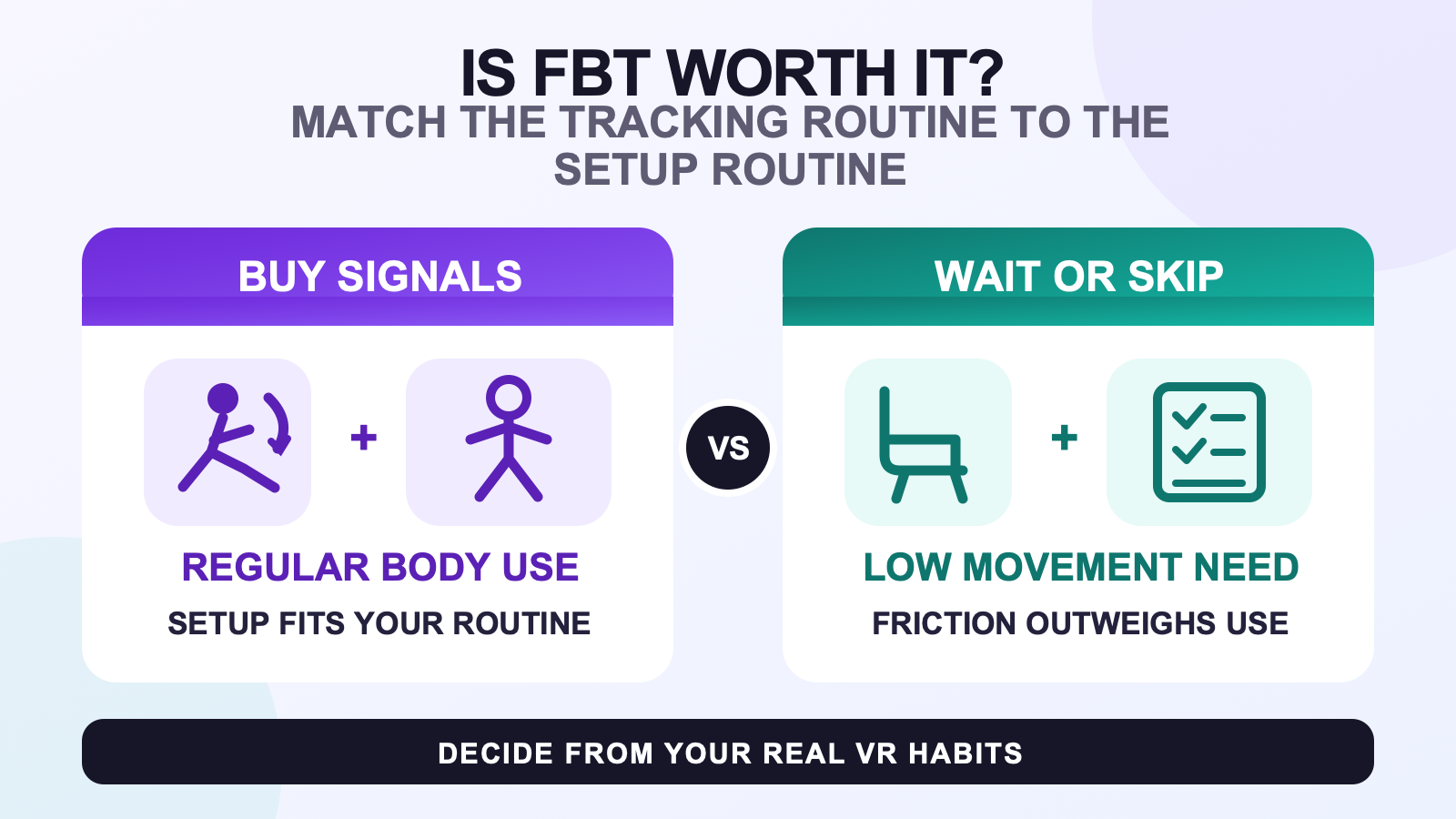
Full body tracking is worth it when your normal VR routine depends on body movement that headset and controller tracking do not capture, and you are willing to repeat the wear, startup, mounting, and calibration work needed to use it. It is a wait if the interest is real but the routine is still uncertain. It is reasonable to skip for now if most sessions are seated, brief, or driven mainly by controllers and the extra setup would keep you from starting VR at all.
That answer is intentionally personal. A compatible tracker can still be poor value for someone who rarely uses the movement it adds. A casual user can still value it if those occasional sessions revolve around dance, performance, or body-led social interaction. The useful question is not whether other people like FBT. It is whether tracking fits the way you already use VR.
Start with the routine you already have
Look back at real sessions instead of imagining a future version of yourself. Note what you open, how you move, how long you stay, and what makes you stop. If most of your time is in VRChat, use the VRChat buyer and setup guide to separate platform setup from the value decision. If most sessions happen in a chair, the seated VR guide is a better reality check than a standing dance demo.
| Decision input | Stronger value signal | Reason to pause |
|---|---|---|
| Use pattern | You return to body-led social or performance activities | Your VR use is still experimental or inconsistent |
| Movement need | Hip, leg, foot, or torso movement is part of the activity | The activity works mainly through head, hands, buttons, or a seat |
| Setup willingness | You accept staging, wearing, checking, and calibrating hardware | Extra startup steps already make you abandon sessions |
| Opportunity cost | FBT addresses the clearest limitation in your routine | Another upgrade would solve a problem you encounter more often |
No single row decides the answer. Look for a consistent pattern. Strong movement need with low setup tolerance often means wait and simplify the routine first. High enthusiasm with no repeated use case is also a wait signal, not a failure.
Decide whether body movement is central
FBT has more personal value when the activity itself uses the body points you want tracked. That can include body-led social presence, dance practice, performance, posing, or other scenes where lower-body motion is part of what you are doing. It has less value when legs and hips are mostly outside the task.
Ask one concrete question after a normal session: what movement did I want the avatar or application to receive that it could not receive today? A specific answer is useful. A vague wish for a more advanced setup is not yet a reason to buy.
Do not turn that question into a tracker-count decision. Count belongs later, after the movement goal and technical route are clear. The category-neutral FBT buying guide covers that broader route selection without changing the conclusion of this page.
Count the recurring setup work
The hardware does not disappear between sessions. A routine may include charging and staging, putting trackers in their assigned positions, checking strap fit and orientation, starting the required software, and calibrating before use. The exact path depends on the tracking system, but the existence of recurring work is not hypothetical.
The official SlimeVR Quick Setup says trackers need flat-surface calibration after power-on and that later sessions still use the mounting calibration workflow. Its wearing guide also documents body roles, mounting orientation, secure fit, and placement adjustment. The official VRChat full-body tracking guide documents an in-app calibration flow. None of those sources promises a universal setup time.
Use the charging and pre-session checklist and the strap and placement guide to picture the work before buying. If comfort is already a concern, read the long-session comfort guide. If the room changes what you can safely do, check the small-space room setup guide.
A useful test is simple: would you still choose this routine on a tired day? If the answer is no, the setup may become shelf hardware even when it works correctly.
Use opportunity cost instead of a magic budget number
There is no universal price at which FBT becomes worthwhile. The same purchase can compete with a headset replacement, PC improvement, audio, comfort accessories, or money kept for something outside VR. Rank the limitation you notice most often, then ask which purchase addresses it directly.
If cost is the main pressure, use the budget tradeoff checklist. This article does not repeat current prices or call one option cheap. A low sticker price cannot create a movement need or make recurring setup acceptable.
Choose buy, wait, or skip
| Decision | What your evidence looks like | Next action |
|---|---|---|
| Buy | Your regular activities use body movement, you accept the setup routine, and FBT addresses a clear limitation better than competing upgrades. | Confirm the technical route, then compare the current product facts before checkout. |
| Wait | You want FBT, but your VR habit, movement goal, room, comfort, or willingness to calibrate is still unclear. | Keep a short session record and resolve the uncertain input before choosing hardware. |
| Skip for now | Your usual activities do not depend on tracked body movement, or the recurring setup would stop you from using it. | Spend nothing, improve the clearer limitation, and revisit only if the routine changes. |
Before choosing buy, write one sentence for each input: what you do in VR, which movement matters, which setup steps you accept, and what the money would replace. If any sentence depends on an imagined future habit, move that part to the wait column.
If the evidence points to buy and a SlimeVR-compatible route fits your setup, review the current FBTKit product listing for the FBTKit LSM6DSV SlimeVR-Compatible Full Body Tracking Kit. Recheck the live product details before checkout. If the evidence points to wait or skip, there is no reason to force a product decision today.
Frequently asked questions
Is full body tracking worth it for occasional VR sessions?
It can be, but frequency alone does not decide it. The stronger signal is whether those sessions regularly depend on tracked lower-body or full-body movement and whether you are willing to complete the wear and calibration routine each time.
Does full body tracking make sense if I mainly use seated VR?
Sometimes. It depends on whether your seated activities benefit from the body points your setup can provide. If lower-body movement is rarely part of the activity, waiting or skipping may be the better use of the budget.
Should I buy FBT if I dislike calibration?
Probably not yet. VRChat and SlimeVR both document calibration steps as part of use. If that recurring work already feels unacceptable, the hardware is unlikely to fit your routine even if the tracking method is compatible.
What should I test before deciding that FBT is worth it?
Track your normal VR sessions for a while: what you do, whether body movement is central, whether you finish sessions wanting more tracked motion, and whether setup friction would stop you from starting. Use that record instead of a generic popularity claim.
When is skipping FBT the sensible choice?
Skip for now when your usual activities do not depend on tracked body movement, most sessions are too brief for the setup to feel worthwhile, or another VR upgrade would solve a clearer limitation. You can revisit the decision when the routine changes.
Evidence note: Product identity was checked on August 11, 2026. Workflow statements come from the official VRChat and SlimeVR documentation linked above. This guide does not claim first-hand testing or guarantee a personal outcome.
