
Blog
Full Body Tracking vs Phone Based Tracking
Jul
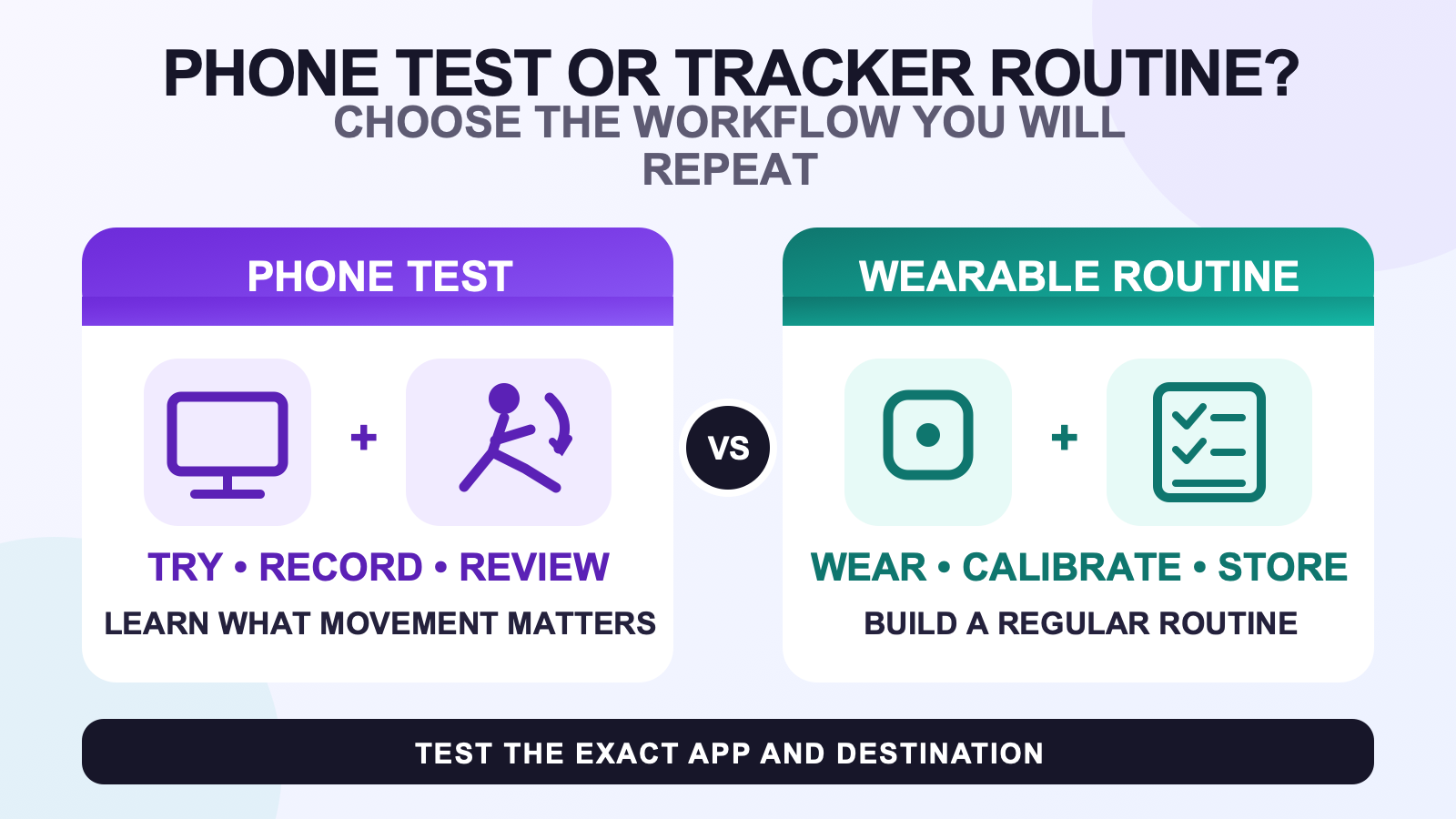
Full body tracking versus phone based tracking is best treated as an experiment decision. A phone method can help you find out whether lower-body avatar movement matters to you. Dedicated wearable trackers make more sense when you already want that movement in regular sessions and are willing to maintain charging, placement, software, and calibration.
There is no universal phone workflow in this comparison. Apps can use different sensors, cameras, bridges, network paths, and supported destinations. Test the exact phone software you are considering. Do not assume that a result shown in one video applies to your phone, headset, room, or social VR route.
Decide whether you need a trial or a routine
A trial answers a narrow question: does seeing more of your posture or leg movement change the experience enough to keep exploring? A phone you already own may be a reasonable way to run that trial if the chosen app supports your headset and destination. Keep the test short and write down what worked, what failed, and which movements mattered.
A routine has a higher standard. It must be easy enough to repeat on an ordinary evening, not only when you have time to rebuild the setup. Count every launch step, network connection, phone position, calibration action, and recovery step. If the process is annoying after two or three sessions, the low entry cost did not create a useful routine.
Compare the complete workflows
| Decision factor | Phone based test | Dedicated wearable trackers |
|---|---|---|
| Best first question | Do I care enough about body movement to continue? | Which wearable route fits sessions I already repeat? |
| Dependencies | Exact phone, app, camera or sensor mode, network, bridge, and destination | Tracker system, server or receiver, straps, charging, calibration, and destination |
| Session preparation | Launch and position the phone workflow as its documentation requires | Identify, wear, connect, and calibrate the trackers |
| Useful evidence | A recorded trial in your normal room | A written route and repeatable setup checklist |
| Reason to stop | The app path is unsupported or the trial adds little value | The wearable routine does not fit your room or habits |
The table compares jobs, not accuracy. Without a controlled test of named products, there is no basis for claiming that one method is always smoother, faster, or more precise. If you also want to compare a fixed camera method, use the webcam body tracking comparison.
Run a phone trial that produces useful notes
Choose one destination and one movement set. Test standing, turning, sitting, and the movement you care about most. Keep the room and headset route consistent. If possible, record the avatar view so you can inspect the same moments later instead of relying on memory.
- Name the phone model, operating system, tracking app, and destination.
- Write how tracker data reaches the headset or PC application.
- Test the normal room, lighting, network, and phone position.
- Repeat the same short movement sequence twice.
- Record setup time as a personal observation, not a universal benchmark.
- List the failures that would make you skip the method next week.
This note is more useful than a broad impression that the test was “good” or “bad.” It tells you which problem a dedicated setup would need to solve.
Know what dedicated trackers change
Wearable full body trackers move the setup work onto the body. You charge devices, assign roles, use stable mounting positions, calibrate, and maintain the software path. That is more hardware than a phone trial, but the hardware has a defined job in the routine.
Dedicated does not mean automatic. Use the setup and calibration workflow to estimate the session steps. Check the compatibility route before assuming that a wearable kit works with the same headset and app path as the phone method.
Choose based on expected weekly use
If you are curious and have not yet seen your avatar use lower-body movement, a phone test can be enough. If you regularly spend time in social VR, practice avatar poses, or record clips and already know that body movement matters, compare dedicated trackers. The category explainer, what full body tracking adds in VR, can help define that goal.
Use frequency is only one filter. Room, compatibility, comfort, support, and setup patience can still rule out a purchase. The worth-it guide turns those factors into a personal decision without promising that hardware will suit everyone.
Do not confuse a test with compatibility proof
A successful phone trial proves that one phone workflow reached one destination under the conditions you tested. It does not prove that a dedicated tracker system uses the same output, or that another app will accept it. Run a separate route check for any hardware under consideration.
The reverse is also true. A frustrating phone test does not prove that wearable tracking will solve the problem. Identify whether the failure came from app support, the network, camera position, room conditions, or your interest in the result. Then compare the relevant dependency.
Compare a wearable route after the trial
The FBTKit SlimeVR-compatible tracker kit uses wearable IMU trackers and SlimeVR Server. Review the live product page and current documentation if your phone notes show that you want a repeatable body-tracking routine.
FAQ
Is a phone test useful before buying wearable trackers?
Yes, if the exact phone app supports your route. Use the test to learn whether body movement matters and which setup problems you would want dedicated hardware to solve.
What makes a phone tracking workflow hard to repeat?
Any repeated friction can matter, including launching the app, positioning the phone, keeping the network path stable, calibrating, and recovering when the destination stops receiving data.
Should regular social VR users move to dedicated trackers?
They should compare dedicated trackers when body movement already matters in regular sessions. Compatibility, room, comfort, support, and setup patience still need separate checks.
Can a phone experiment confirm headset compatibility?
It confirms only the exact phone, software, connection, headset, and destination route tested. It does not prove that another tracking method uses the same path.
What should I record during a phone trial?
Record the exact software route, room conditions, setup steps, a short repeated movement sequence, visible failures, and whether you would willingly repeat the process next week.
